



Most trading websites say they are "regulated" somewhere on the page, often next to a regulator's logo and a license number. That claim takes seconds to copy. Checking it takes about ten minutes, and it is the single most useful thing you can do before sending a broker any money.
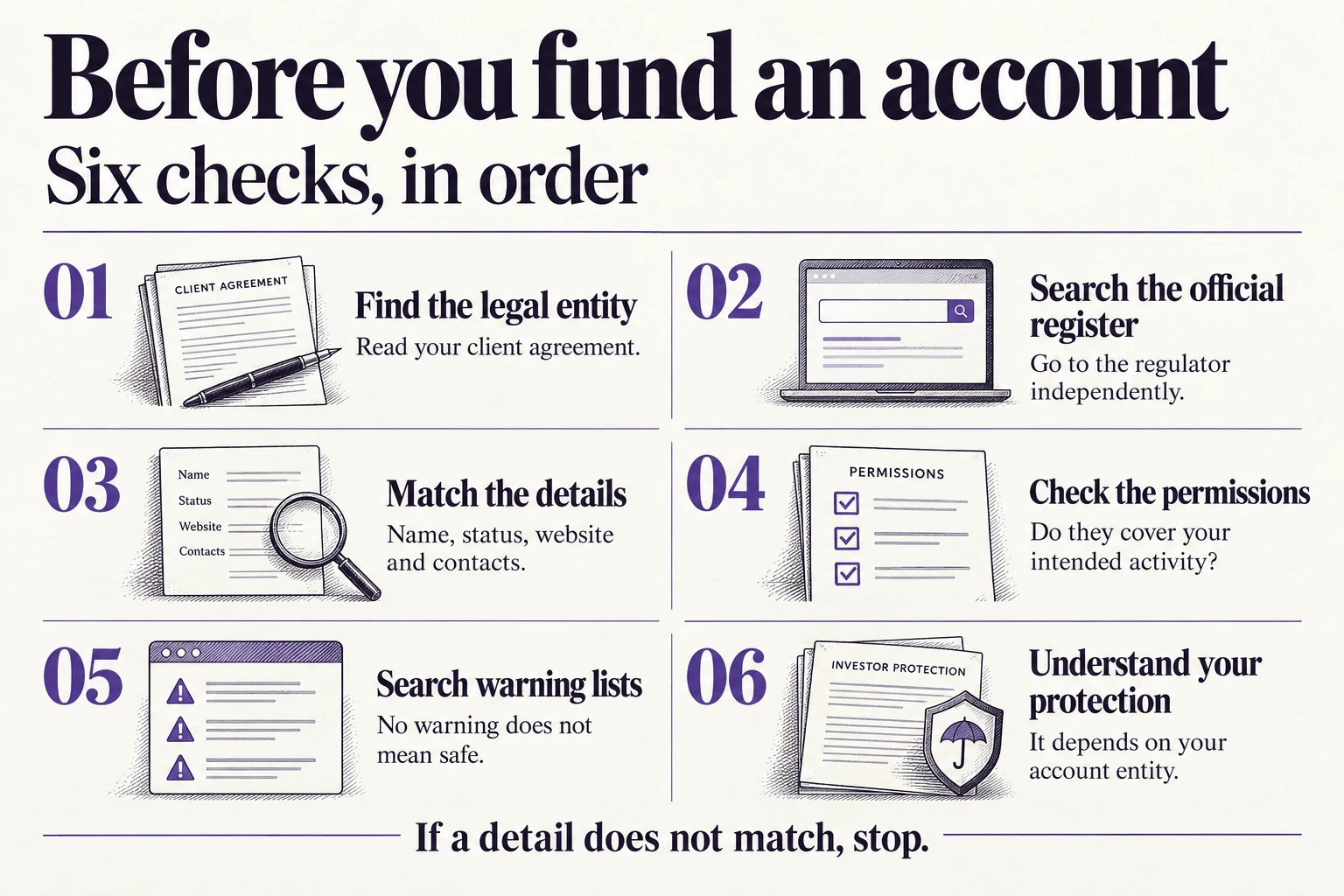
This guide walks through the checks in order: finding the company behind the brand, searching the right official register, confirming the details match, checking what the firm is allowed to do, searching warning lists, and working out what protection you would actually have. It covers the UK, US, EU and Australian regulators most often named by brokers. The same method works anywhere.
Why a license badge is not enough
There are three common problems a quick look at a broker's website will not reveal.
The brand is not the company. Many trading brands operate through several legal entities in different countries, each with its own license and rules. The entity that opens your account depends on where you live and sometimes on the account type you choose. A brand can be well regulated in one country and serve customers elsewhere through a subsidiary with far lighter oversight.
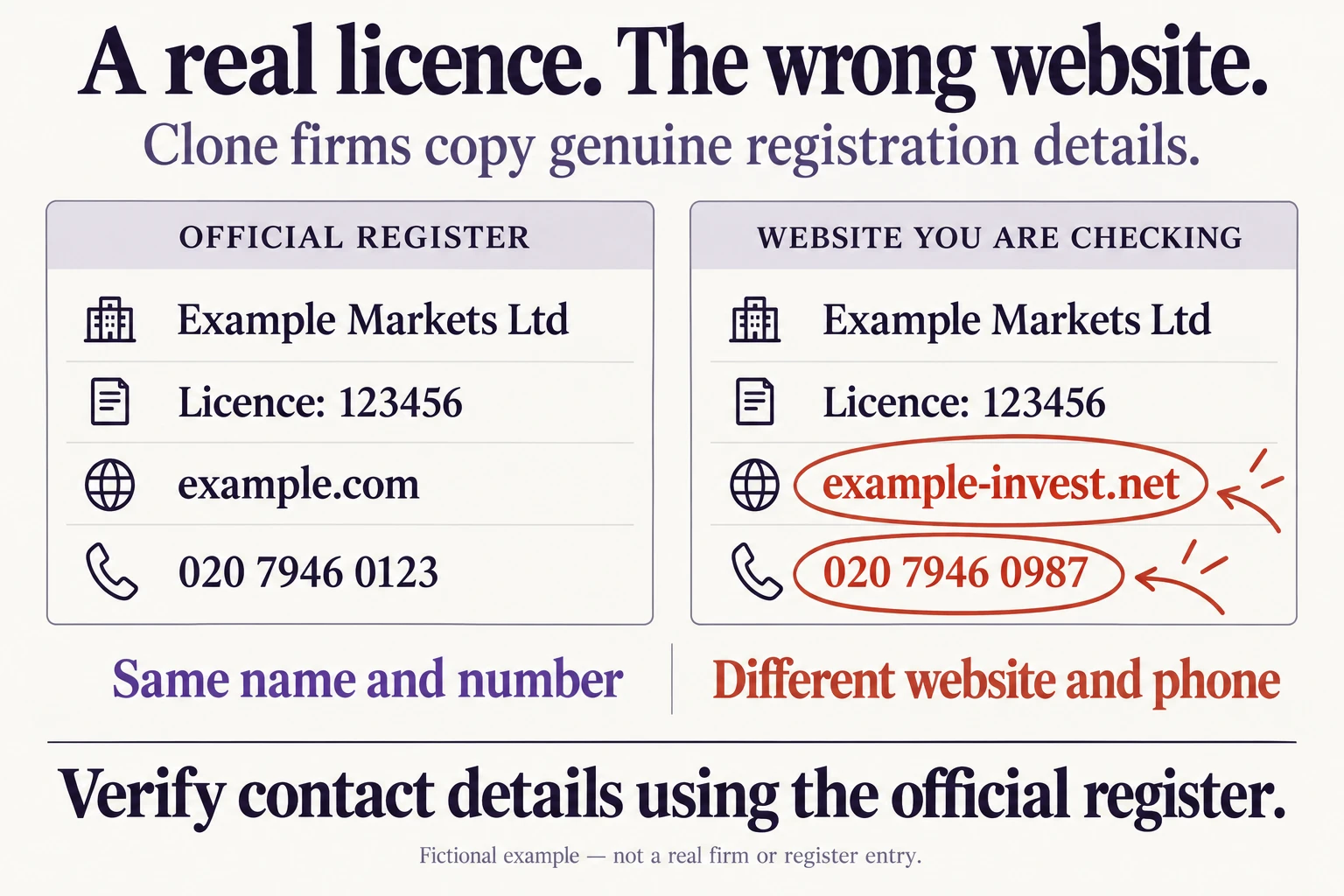
The details may be stolen. The UK Financial Conduct Authority (FCA) warns about "clone firms": fraudsters who use the name, address and Firm Reference Number of a genuine authorized firm to appear legitimate.[1] A real registration number tells you nothing if it belongs to someone else.
The regulator may not be real. The US Securities and Exchange Commission keeps a public list that includes entities falsely claiming to be registered and fictitious regulators or international bodies invented to make a scheme look official.[2] If you have never heard of the regulator named on a website, check that it exists before checking the firm.
What you need before you start
Gather these details from the broker's website footer, its client agreement or terms of business, and any account-opening documents. If you cannot find them, that is already informative.
| Detail | Where to find it | Why it matters |
|---|---|---|
| Full legal entity name | Client agreement, terms, website footer | Registers list companies, not brand names |
| Registration or license number | Website footer, legal documents | Lets you find the exact record |
| Regulator named | Website footer, "regulation" page | Tells you which register to search |
| Website address and phone number | The site itself | Compared with the register to spot clones |
| Country of the entity that would hold your account | Client agreement, account application | Decides which rules and protections apply |
Step 1: Identify the company you would actually deal with
Open the client agreement or terms of business, not the marketing pages, and find the name of the company that is party to the agreement. That entity, not the brand, is the one whose regulation matters to you.
Look for statements such as "services are provided by…" or a list of group companies with the countries they serve. If the site lists several entities, work out which one would accept a customer from your country. Some brands state this on the account application; others only reveal it in the agreement you are asked to accept.
If you cannot find any legal entity name, or the documents name a company in a different country from the regulator advertised on the homepage, treat that as a serious warning sign.
Step 2: Search the regulator's own register
Every regulator listed below publishes a free, searchable public record. Search by the legal entity name or registration number you found in step 1.
| Where | Regulator | What to search | What it shows |
|---|---|---|---|
| United Kingdom | Financial Conduct Authority (FCA) | Financial Services Register | Firms and individuals the FCA or PRA has authorized, plus unauthorized firms and clones it has warned about[3] |
| United States: forex and futures | Commodity Futures Trading Commission (CFTC), via the National Futures Association | NFA BASIC | Registration, disciplinary or regulatory history and financial information[4] |
| United States: securities brokers and advisers | Securities and Exchange Commission (SEC) and FINRA | Investor.gov search, FINRA BrokerCheck | Whether a firm or individual is registered or licensed, qualifications, and disciplinary and employment history[5] |
| European Union and EEA | The national regulator that authorized the firm, with a central list kept by ESMA | The national regulator's register, or ESMA's register of investment firms | Investment firms authorized by national regulators and the services they may provide[6] |
| Australia | Australian Securities and Investments Commission (ASIC) | ASIC's professional registers | Australian financial services licensees and authorized representatives, by name or license number[7] |
For a firm authorized in an EU country, the advertised regulator is usually the national authority in that country. Search its register first, then confirm on ESMA's list.
If a broker names a regulator outside these jurisdictions, find that regulator's official website independently and look for its public register. If it has no searchable register, or you cannot find the regulator at all, you cannot verify the claim.
Step 3: Make sure every detail matches
Finding a firm with the right name on a register is not the end of the check. Compare the register entry with what you have in front of you:
- Name: the legal entity name should match exactly, not approximately. Clone firms often use a genuine firm's name with small changes, or the exact name with a different website.
- Status: look for a current authorization. Registers also list firms that are no longer authorized.
- Website: the domain you are using should appear on the register entry, or be clearly connected to it.
- Phone, email and address: these should match the contact details on the register.
The FCA advises that if a financial business contacts you unexpectedly, you should reply using the contact details shown on its register, not those the caller gives you.[8] ASIC gives similar advice: check the license holder's name and number on its registers and make sure those details match the business or investment being promoted.[7]
Step 4: Check what the firm is allowed to do
Authorization is not all-or-nothing. A firm can be authorized for some activities and not others, so check that its permissions cover what you plan to do: dealing in investments, holding client money, offering derivatives such as CFDs, or arranging trades through another firm.
Pay particular attention to firms acting on behalf of another company. In the UK, an "appointed representative" carries out regulated activities under the responsibility of an authorized principal firm. The FCA notes that if an appointed representative operates beyond what it is permitted to do, you may not be protected by the Financial Ombudsman Service or the Financial Services Compensation Scheme.[3]
In the US, the CFTC's advice is to verify the registration status and disciplinary history of the person or firm selling a product before researching its risks or potential returns.[4]
Step 5: Search warning lists, but do not stop there
Regulators publish lists of firms they have identified as unauthorized or suspicious. Search the broker's brand name, company name and website address.
| List | Published by | What it covers |
|---|---|---|
| Warning List | FCA (UK) | Firms operating without authorization, scams and clones of authorized firms[8] |
| RED List | CFTC (US) | Foreign entities that appear to require CFTC registration but are not registered[9] |
| PAUSE list | SEC (US) | Entities falsely claiming US registration, fictitious regulators and impersonators of registered firms[2] |
| Investor Alert List | ASIC Moneysmart (Australia) | Companies and websites that do not hold an ASIC license and may be targeting Australians[7] |
| I-SCAN | IOSCO (international) | Alerts from member regulators worldwide about unauthorized firms, in one search[10] |
A clean result proves very little. The FCA states plainly that a firm missing from its Warning List may still be unauthorized or a scam, because unauthorized firms often change their names.[8] Treat warning lists as a way to rule firms out, never to rule them in.
Step 6: Work out what protection you would actually have
Once you know which entity would hold your account and who regulates it, you can work out which protections apply. Two kinds matter most: compensation if the firm fails, and limits on how much you can lose while trading.
Compensation if the firm fails
| Scheme | Who it covers | Limit | Important exclusions |
|---|---|---|---|
| Financial Services Compensation Scheme (UK) | Eligible customers of FCA- or PRA-authorized firms carrying out regulated activities | Up to £85,000 per eligible person, per firm, for firms that failed after 1 April 2019 | Does not cover poor investment performance, unregulated activities or unauthorized firms[11] |
| Securities Investor Protection Corporation (US) | Customers of SIPC-member brokerage firms | Up to $500,000, including a $250,000 limit for cash | Does not protect commodity futures contracts (except in portfolio margining accounts) or foreign exchange trades[12] |
These schemes exist to return assets that a failed firm should have held for you. They do not compensate you for losing money on trades.
Limits on leveraged trading
Contracts for difference (CFDs) let you trade with borrowed exposure, which magnifies losses as well as gains. When the European Securities and Markets Authority (ESMA) restricted CFDs for retail clients in 2018, it reported that national regulators' analyses showed 74–89% of retail accounts typically lost money, with average losses per client of €1,600 to €29,000.[13]
Regulators in the EU and Australia set maximum leverage for retail CFD clients by asset type:
| Underlying asset | EU (ESMA 2018 measures) | Australia (ASIC) |
|---|---|---|
| Major currency pairs | 30:1 | 30:1 |
| Non-major currency pairs, gold, major indices | 20:1 | 20:1 |
| Commodities other than gold, non-major indices | 10:1 | 10:1 |
| Individual shares and other assets | 5:1 | 5:1 |
| Crypto assets | 2:1 | 2:1 |
| Losses limited to funds in the account | Yes, per account | Yes |
| Margin close-out | At 50% of minimum required margin | Standardized close-out required |
Sources: ESMA[13] and ASIC.[14] ESMA's measures began as temporary EU-wide restrictions. ASIC has extended its order to 23 May 2027.[14]
In the UK, the FCA made permanent rules for CFDs sold to retail clients from 1 August 2019. They limit leverage to between 30:1 and 2:1, require positions to be closed when a customer's funds fall to 50% of the margin needed, and guarantee that a client cannot lose more than the total funds in their CFD account.[15]
Red flags to take seriously
Any one of these is a reason to stop and investigate further. Several together are a reason to walk away.
| Red flag | Why it matters |
|---|---|
| No legal entity name or registration number anywhere on the site | You cannot verify a company you cannot identify |
| The registration number belongs to a firm with a different name or website | A classic sign of a clone firm |
| A regulator you cannot find on an official government website | Fictitious regulators are used to make schemes look legitimate |
| Your account would be opened with an entity in a different country from the advertised regulator | Your protections depend on that entity, not the brand |
| Unexpected contact, pressure to deposit quickly or promises of guaranteed returns | Common features of investment fraud |
| Requests to pay into a personal bank account or a crypto wallet | Not how a regulated broker would normally ask you to fund an account |
What regulation does not do
Regulation sets standards for how a firm must behave and, in some countries, gives you access to complaints services and compensation if the firm fails. It does not:
- protect you from losing money on trades you choose to make;
- mean that a product is suitable for you;
- guarantee that every customer of a brand receives the same protection.
We explain how SafeTrading applies these distinctions in its research in our review methodology. Read our risk disclaimer for the limits of general guidance like this.
If something does not check out
If the details do not match, or you cannot verify the firm at all, do not deposit money. If you have already paid:
- Contact your bank or payment provider straight away and explain what happened.
- Stop sending money, including any "fees" or "taxes" requested to release a withdrawal.
- Keep records: the website address, messages, payment receipts and the names and numbers used.
- Report the firm to the regulator whose register you checked, and to the police or national fraud reporting service in your country.
A quick checklist
- Find the full legal name of the entity that would hold your account.
- Search that name and number on the regulator's own register, reached independently.
- Confirm the name, status, website and contact details all match.
- Check that the firm's permissions cover what you plan to trade.
- Search the brand, company and website on the relevant warning lists.
- Work out which compensation scheme and trading protections, if any, apply to you.
- If anything does not match, stop.